 Produuz.it Docs
Appearance
Files and Update designs
Upload Files
Files for each project are uploaded in Files, in the project menu under Designs:
Click Upload. In the upload dialog, pick a file group first, and optionally a tipo, then drop, paste or browse the files and click Upload. The file group tells the system what the file is, and you choose it yourself. It starts on Assembly drawings (.pdf).
When the upload ends, the dialog shows how many files were uploaded and an Update designs button. Nothing runs on its own: you decide when the designs are updated, for example after the last of several uploads.
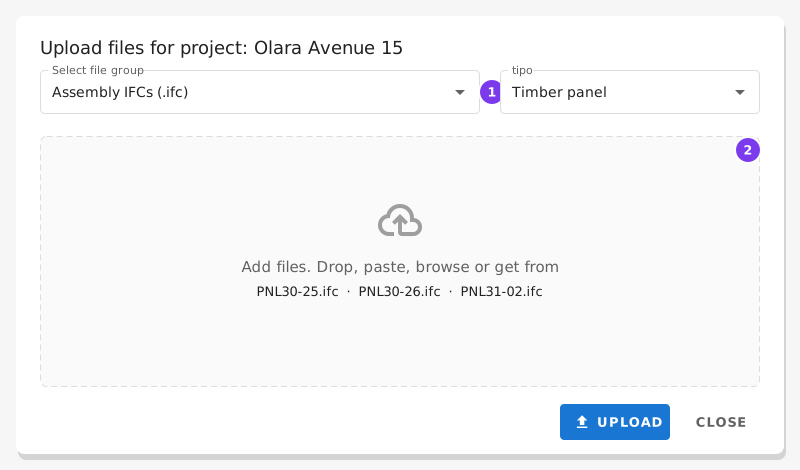
- The file group: what the files are. Pick it before you add the files.
- Drop, paste or browse the files. All of them get the group you picked.
The file groups are:
- Assembly Files: Assembly IFCs (.ifc), Extra Assembly IFCs (.ifc), Assembly drawings (.pdf), Machine Files (.jjs, .wup, .btl).
- Module Files: Module IFCs (.ifc), Extra Module IFCs (.ifc), Module drawings (.pdf).
- Project Files: Project IFCs (.ifc), External IFCs (.ifc), Project drawings (.pdf).
- Details and documentation: Details (.pdf), Documentation (.pdf, .jpeg, .png), Specifications (.pdf, text). Documentation and specifications can also be added as text with the Add as text switch.
The file name decides which design a file belongs to:
IFCs: used for the 3D viewer, BoMs and machine files. The system reads them with the project's IFC Parsing Setup. The file name without extension is the design name. Example: "PNL30-25.ifc" belongs to design "PNL30-25".
Extra IFCs: the design name is the part before the first " - ". Example: "PNL30-25 - Installations.ifc".
Machine files: the file name without extension is the design name. Example: "PNL30-25.btl".
Full Project IFCs
You can also upload full project IFCs and the system can split them into one IFC per design. Upload them in the Project IFCs (.ifc) group. The file name does not matter. Example: "OlaraAvenue15.ifc".
Drawings: .pdf file format. They are shown in the viewer. Drawing file names must follow the format "Merk DESIGN_NAME - DRAWING_NUMBER - DRAWING_NAME.pdf". The word "Merk" at the start is optional. Example: "Merk PNL30-25 - 1 - Zone 0 MAIN VIEW.pdf". If a drawing name does not follow this format, the upload shows a warning.
Details and documentation: .pdf file format. Also shown in the viewer. The file name without extension is the detail name that the system looks for in drawings. Example: "V-12.pdf". Documentation files are linked to every design of the project.
Full Project PDFs
In design mode, the viewer shows a "General Arrangement" entry at the top of the list. It opens the full project IFCs in 3D and the drawings uploaded as Project drawings (.pdf), one button per drawing.
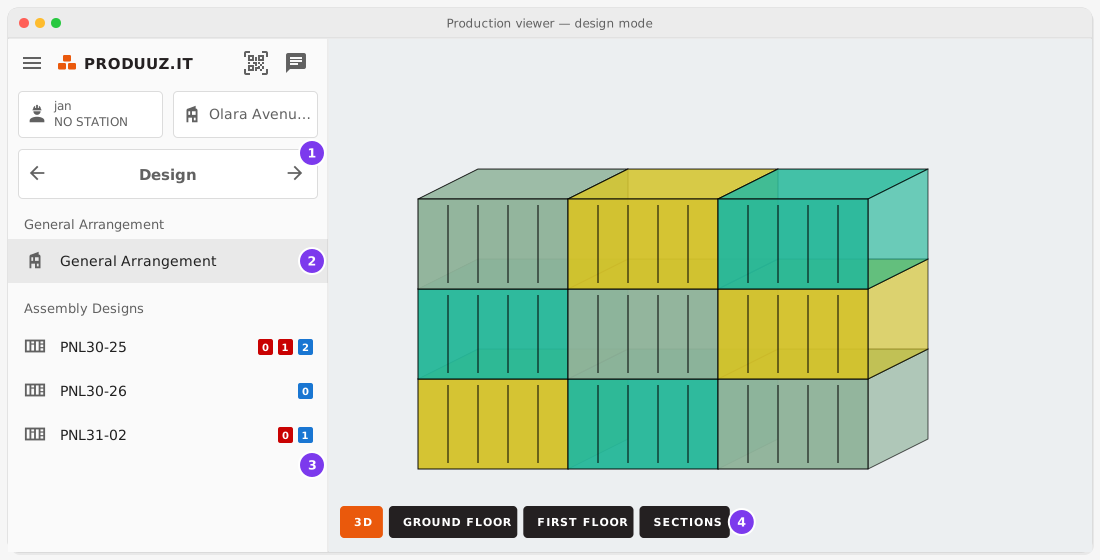
- The list filter set to Design.
- The General Arrangement entry.
- The designs, with their revisions. Older revisions are red.
- 3D and one button per project drawing.
Table of uploaded files
The table of files is shown below the upload summary. The summary counts the files, how many are linked to a design and how many name a design that does not exist, and shows the project's parsing setup with a link to change it.
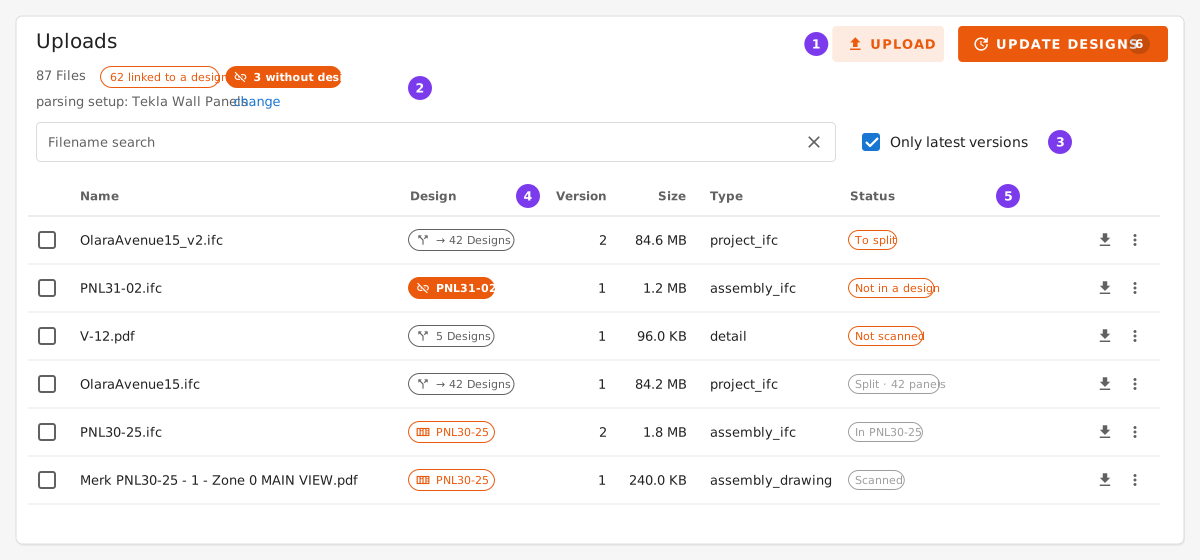
- Upload and Update designs. The number on Update designs counts the pending files.
- The summary: files, files linked to a design, and files that name a design that does not exist.
- The search and Only latest versions.
- The design of each file. A full IFC shows how many designs came out of it; an orange chip names a design that does not exist.
- The status of each file, explained below.
Use Filename search to filter the table, and Only latest versions to hide older versions of files uploaded again with the same name. Select rows to delete, download or update designs from several files at once. The Design column shows the design each file is linked to.
Each file shows one status. The orange ones are pending: the next Update designs takes them in.
| Status | Description |
|---|---|
 | A Project, External or Module IFC that has not been split yet. |
 | A design file (IFC, BTLx, drawing, machine file) that is not attached to its design yet. |
 | A drawing or detail that has not been scanned for detail names yet. A drawing only waits for this when the project has details or specs to find in it. |
 | An update is running and works on this file. A file in this state cannot be deleted. |
 | The file is being split. The percentage updates while the split runs. |
 | The split failed for this file. Click the status to see the warnings. |
 | This full IFC has been split. |
 | The file is attached to its design. |
 | The file has been scanned for detail names. |
The project menu shows the same number on Files from any page of the project, so you see that files are waiting without opening this view. While an update runs, the menu shows a spinner there, and a red mark if it failed.
Update designs
Update designs brings the project's designs in line with its files. It runs three steps, in this order:
- Split building IFCs: Project, Module and External IFCs become one IFC per panel (and per module).
- Create and revise designs: designs are created and get the files that belong to them.
- Link details: drawings and IFCs are scanned for detail names.
There is one button, Update designs, at the top of the table:
- With no file selected it works on every file of the project and does what is pending in them: the files with an orange status. The button shows how many there are. This is the usual way after an upload.
- With files selected in the table it says Update designs from N files and works on those files only, and always does them, even if they were already done: for example to split a file again after deleting its outputs or after a fix, or to update only some designs. A Module IFC made by a split is split again too when you select it.
It opens a dialog that shows what will happen before anything runs.
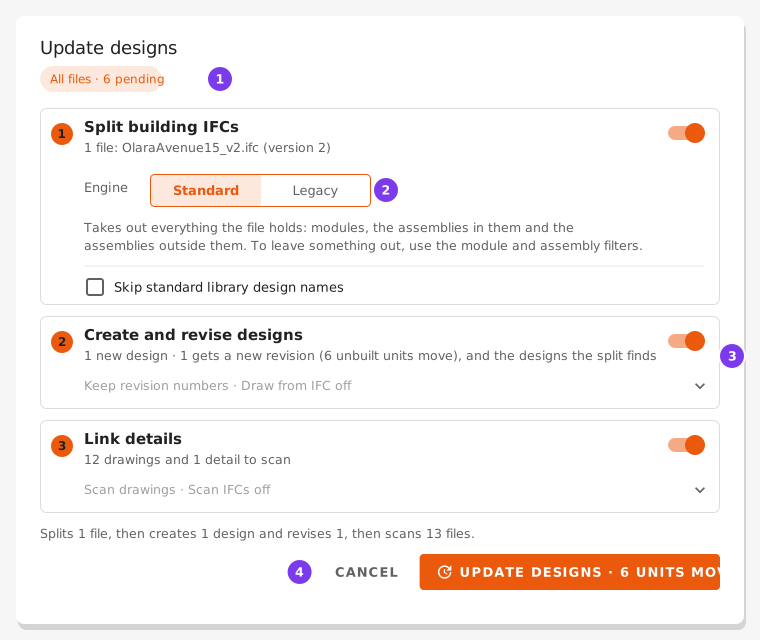
- What the update works on: all the files, with how many are pending, or the selected ones.
- The splitting engine, see Split building IFCs.
- What each step will do: the files to split, the designs that are created or get a new revision, and the unbuilt units that move to the new revision.
- The plan in one sentence, and the button. When units move, the button says how many.
Each step has a switch. With selected files, every step that can take one of them starts on. With no selection, a step starts on when it has pending files, and off when it has none; the step then says what it already did, for example Nothing pending · 2 building IFCs already split. You can always turn it on: it then takes the files it already did again. This is what you need after changing the IFC Parsing Setup, when the building IFCs must be split again. To do only some files again, select them in the table. The settings are folded under the step, and the dialog opens with the settings of the project's last update.
While an update runs, the banner lists the three steps: a spinner on the one running, with its progress, a check on the ones done, and an empty circle on the ones waiting.
While the update runs, a banner above the table shows the step and its progress. When it ends, the banner shows how many designs are new or revised, which files could not be split, and the split warnings. The table, the designs and the counts reload on their own. Close the banner when you have read it.
Only one update runs in a project at a time. Production Counts stays open while the IFCs are split, and is locked while designs are created and revised, until the update ends: that step moves units and counts to the new revisions.
The update stopped responding
An update reports its progress every minute. If it reports nothing for 30 minutes, the banner says The update stopped responding and offers Mark as stopped, which unlocks its files so you can start a new one. If it was still running after all, it finishes anyway.
Split building IFCs
Full IFCs are split into one IFC per design. The new files are added to the project as Assembly IFCs (and Module IFCs) and can be downloaded. The split also stores the quantity of each design and the phases and batches found in the IFC, so they are available in Production Counts. How assemblies are found in the IFC depends on the IFC Parsing Setup.
The split is available when the IFC splitter module is enabled for your company. The designs of the split files are created in the next step of the same update.
There are two engines:
- Standard takes out everything the file holds: the modules, the assemblies in them and the assemblies at the project root. To leave modules or assemblies out, use the Module filter and the Assembly filter of the IFC Parsing Setup.
- Legacy makes one IFC per assembly. It cannot split a parsing setup that finds assemblies by a part property.
A Module IFC you upload is split like a project IFC: it is a partial revision of the project, for example one module exported again. The file is the design file of its own module, so the split does not write that module out again: it takes out its assemblies, and any other module the file holds. The update makes the design of the module and of its assemblies. Without the splitter module an uploaded Module IFC is only a design file. Every Module and Assembly IFC, uploaded or made by a split, goes to the designs. When several files name the same design, the design takes the one exported last, by the time written in the IFC; of the versions of one file, the highest. If you upload a new version that was exported before the previous one, the update warns you: it is probably an old export uploaded by mistake.
A project keeps the engine it was split with. A project that was never split starts on Standard. If you switch engine on a project that was already split, the dialog warns you: design names can differ between engines, and designs that change name are created again.
Settings
☑️ Skip standard library names Does not create IFCs for designs that already exist in the standard library.
If a file cannot be split, the other files go on, and the designs of the failed file are left as they were.
Create and revise designs
The system collects the IFCs, drawings and machine files and creates "design" objects.
A list of design names is built from the file names of assembly and module IFCs, drawings and machine files.
Each file is attached to its design. All the documentation files are linked to every design, so they are always available.
When a design gets a new file, it gets a new revision, and its units that are not built yet move to the new revision.
Units are not created here. Create them in Production Counts with Update production.
Settings
☑️ Keep revision numbers Designs keep their revision number when they get new files.
☑️ Draw from IFC Generates drawings from the IFC of each design, with the default set of views.
Link details
Details can be automatically detected in IFCs and PDF drawings. Found detail names are linked to the design and then shown in the viewer. Only the drawings that were not scanned yet are scanned; when a new detail is uploaded, every drawing is scanned again for it. In a project with no details and no specs, drawings are not scanned and do not count as pending.
Settings
☑️ Scan drawings Drawings are scanned to find detail and specification names, and details are scanned to find specification names. On by default.
☑️ Scan IFCs IFCs are scanned for detail names in the property "DET_NUMBER".
If your detail names can't be detected by the system, you may have a rasterized export, or a rasterized font in a vectorized export, such as the well known issue with AutoCad.
Analysis (prepare the viewer)
The analysis starts automatically when a design gets a new IFC, for example after Update designs. There is no button for it in the Update designs dialog. If the company setting Launch analysis automatically is off, or you need to run it again, select the designs in Designs and click Force analysis. The Analysis column of the designs table shows the status of each design.
Slow task!
⚠️ This operation takes time. It runs many heavy computations and database tasks.
IFC geometry is analyzed to find the rotation and translation matrices (orientation of the panel in the world coordinate system).
Panel size and bruto/neto areas are also calculated here. So if you use bruto areas in Production Counts, you need to wait for this operation.
Each part of the IFC is analyzed, generating drawings and metadata which are saved in the database. This gives fast access to the information when the user clicks on a part in the 3D viewer.
Drawings are only generated for wood and plate parts, and for parts in custom branches marked for logistics in the IFC Parsing Setup. So, if your IFC Parsing Setup is incomplete, some part drawings may be missing.